






Edge Intelligence became the defining catalyst of industrial innovation in 2025, driving the most profound shift since the beginning of digital transformation. As edge AI capabilities matured and combined with 5G private networks and hyper-connected IoT ecosystems, industries finally reached the long-anticipated convergence point. This new level of integration transformed AIoT from a conceptual trend into a measurable strategic advantage—reshaping operational models, cost structures, and sustainability performance across global markets. With Edge Intelligence enabling real-time perception, prediction, and action, enterprises advanced from digital visibility to intelligent autonomy, establishing AIoT as the new industrial operating fabric.
Unlike early digital transformation efforts that mainly improved data visibility, the 2025 wave of AIoT introduced closed-loop intelligence at scale—where sensing, interpretation, prediction, decision, and execution occur at the edge with deterministic speed. As a result, 2025 marked the industry-wide transition from using data more effectively to making systems inherently intelligent.
Table of contents
The Acceleration of AIoT Fusion in 2025
Edge Intelligence Becomes the Default, Not the Exception
Edge Intelligence matured significantly due to three simultaneous drivers:
Computing power at the edge multiplied while cost dropped
Edge AI processors grew from 5–20 TOPS in 2020 to 80–150 TOPS in 2025—at similar or lower power consumption. This performance allowed:
- Real-time defect detection
- Autonomous equipment coordination
- Local model inference without cloud dependency
- Micro-second decision loops for high-speed manufacturing
Industrial AI models became smaller, faster, and more stable
Model compression, pruning, quantization, and TinyML allowed manufacturers to deploy:
- Real-time predictive maintenance
- Edge-based anomaly detection
- Intelligent robot-path optimization
- Vision AI quality inspection
without relying on heavy cloud resources.
AI moved from “trial projects” to “production workloads”
In 2025, over 40% of large factories ran at least five production-grade AI models at the edge, up from 12% in 2023. AI adoption expanded from a few lines to full factory coverage.
5G Private Networks + TSN Becoming the Industrial Nervous System
Why 5G Private Networks Dominated New Industrial Deployments
Industries adopted 5G private networks (5G PNs) because they delivered deterministic, low-latency connectivity unavailable in traditional Wi-Fi or wired systems.
Key performance shifts in 2025:
- End-to-end latency: < 5 ms
- Reliability: 99.999%
- Seamless mobility for AGVs, AMRs, drones, robots
- Network slicing supporting parallel workloads
Consequently, 5G PNs became the default network for next-generation industrial automation systems.
When Combined with TSN, 5G Became a Real-Time Industrial Backbone
TSN (Time-Sensitive Networking) added deterministic timing and synchronization. In 2025, more than 30% of new industrial deployments used 5G + TSN hybrid architectures to unify:
- Robotics
- CNC machines
- Intelligent conveyors
- Precision assembly lines
- Rail and power infrastructure
This integration replaced legacy fieldbus systems and enabled microsecond-level coordination across devices and production cells.
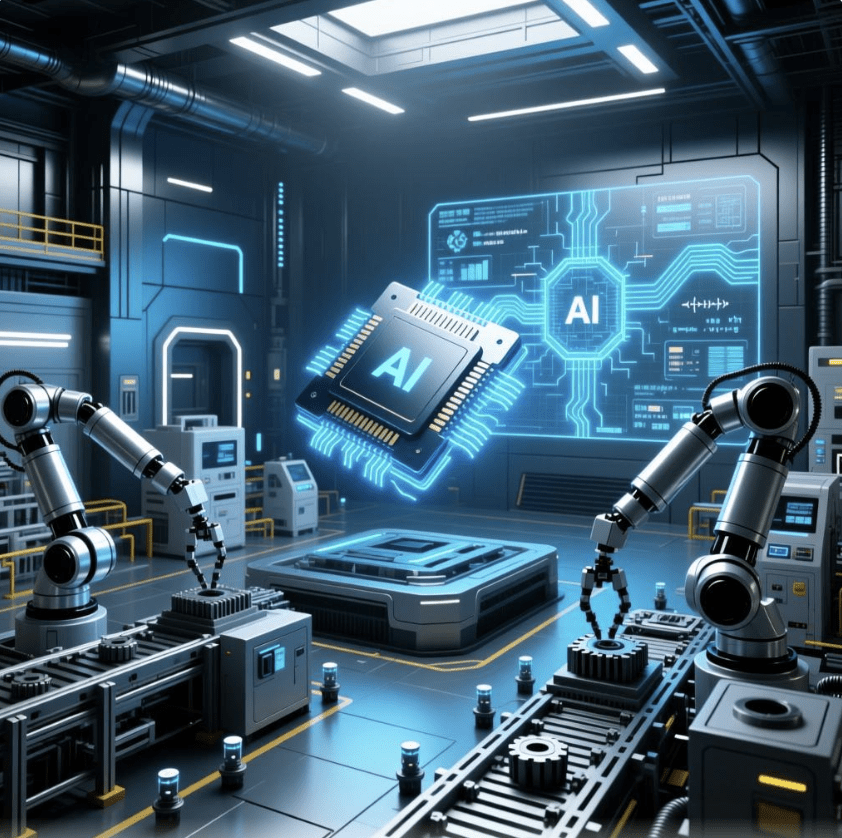
Industry Case Studies: 2025’s Most Transformational AIoT Deployments
Manufacturing: From Digital Factories to AI-Native Factories
Real-Time Twin replaces traditional digital twins
Factories shifted from static digital models to Real-TimeTwins—data-driven, constantly synchronized models combining:
- Multi-modal sensor streams
- Operational rules
- Predictive models
- Resource constraints
- Energy profiles
Real-Time Twins transformed operations:
- Equipment fault detectability improved by 40–60%
- OEE increased 12–18%
- Factory-wide energy consumption reduced 10–15%
Autonomous intralogistics emerged
AI-driven AGVs/AMRs connected via 5G PN executed autonomous missions:
- Material picking
- Path optimization
- Collision avoidance
- Fleet coordination
This autonomy reduced labor dependency and improved material flow stability by 20–30%.
Transportation: Infrastructure Becomes Self-Aware
AIoT reshaped airports, ports, and rail systems
Airports deployed 5G-RTK positioning + AI video analytics to enable:
- Autonomous apron vehicles
- Aircraft taxiway conflict detection
- Passenger-flow optimization
Ports implemented:
- Autonomous container trucks
- AI traffic orchestration
- Digital yard twins
- Vessel ETA prediction models
Urban rail systems adopted:
- 5G-based trackside sensing
- Predictive switch/rail maintenance
- Real-time passenger density routing
Overall, transportation infrastructures reported:
- 25–35% efficiency improvement
- 20–50% incident reduction
- 15–30 minute earlier congestion forecasting
Energy: AIoT Modernizes Power Systems and Renewable Sites
Autonomous power distribution begins
Substations upgraded from traditional SCADA to AI-driven predictive control with:
- Real-time load balancing
- Fault isolation simulation
- Intelligent switching
- Thermal anomaly prediction
These capabilities increased grid reliability significantly.
Renewable energy sites adopted edge-based forecasting
Wind and solar farms used local AI models to predict:
- Turbine performance
- Wind speed fluctuation
- Solar irradiance patterns
- Component failure
With AIoT, renewable output forecasting accuracy exceeded 90%, enabling more stable integration into national grids.
From Digital Transformation to Intelligent Operations
By late 2025, global enterprises reached a strategic consensus: Digital transformation is complete. Intelligent operations must begin.
Digital transformation solved visibility. Intelligent operations solve volatility.
Intelligent operations rely on:
- Real-time twins
- Edge-cloud orchestration
- Predictive workflows
- Closed-loop automation
- AI-based scheduling
- Autonomous decision agents
Instead of dashboards, industries demand self-optimizing systems capable of learning from real-time data.
The Emergence of Autonomous IoT (Autonomous AIoT)
Why 2025 marked the “pre-autonomous era”
Three shifts converged:
- Edge AI inference became reliable
- 5G PN + TSN enabled deterministic connectivity
- Industry knowledge graphs linked silos into unified logic
Combined, they formed the foundation for Autonomous IoT (A-IoT)—systems that can analyze, decide, and act with minimal human involvement.
Autonomy Levels: A Model for Industry
| Level | Description |
| Level 0 | No automation |
| Level 1 | Monitoring + alerts |
| Level 2 | Assisted decision-making |
| Level 3 | Automated decision loops |
| Level 4 (2025–2027) | Cross-system autonomous coordination |
| Level 5 (2030+) | Fully autonomous industry ecosystems |
2025 deployments showed clear movement toward Level 4 autonomy.
Strategic Recommendations for 2026
To prepare for Autonomous IoT adoption, enterprises must:
- Prioritize edge-first architecture
- Deploy 5G private networks with deterministic control
- Build an AIoT middle platform instead of isolated projects
- Invest in Real-Time Twin capabilities
- Adopt a multi-agent operational framework
- Integrate sustainability metrics into intelligent operations
- Shift IT/OT teams toward model governance and orchestration
Conclusion
2025 was not merely a year of progress—it represented a structural shift. The convergence of AIoT, 5G private networks, and real-time intelligence reshaped industrial competitiveness.
Industries entered an era where intelligent systems no longer just optimize operations—they anticipate, adapt, and act.
The Great Convergence is not ending. It is the foundation for the autonomous industrial era that begins in 2026.