


Extreme weather events have become more frequent and more destructive. From coastal typhoons that generate violent crosswinds to inland blizzards that load transmission towers with heavy ice, power grids are facing structural stresses they were never designed for. As a result, utilities worldwide are searching for ways to protect transmission assets proactively rather than reactively. This is where the Intelligent Tower Monitoring System is redefining grid resilience. Unlike traditional inspection models—which depend on periodic manual checks—AI-enabled monitoring infrastructure offers continuous insight, real-time risk prediction, and early-warning capabilities that help prevent failures before they happen.
In this blog, we explore how hybrid sensing, edge AI, and environmental models are transforming tower protection in the age of extreme climate risks.
Table of contents
Why Traditional Tower Protection Falls Short
1.1 Inspections Are Episodic, But Risks Are Continuous
Maintenance teams typically inspect towers every few months. However, typhoons and blizzards can cause dangerous structural changes in minutes, making periodic inspection insufficient.
1.2 Weather is Becoming More Unpredictable
Climate models show a rising frequency of storms exceeding historical baselines. Typhoon paths shift more abruptly; blizzards form and intensify faster than 10 years ago.
1.3 Failure Is Often Cascading
One tower collapse may pull down adjacent spans. Outages then expand to regional grids, affecting industries, hospitals, and entire cities.
A new approach is required—one based on continuous, intelligent monitoring.
Inside an Intelligent Tower Monitoring System
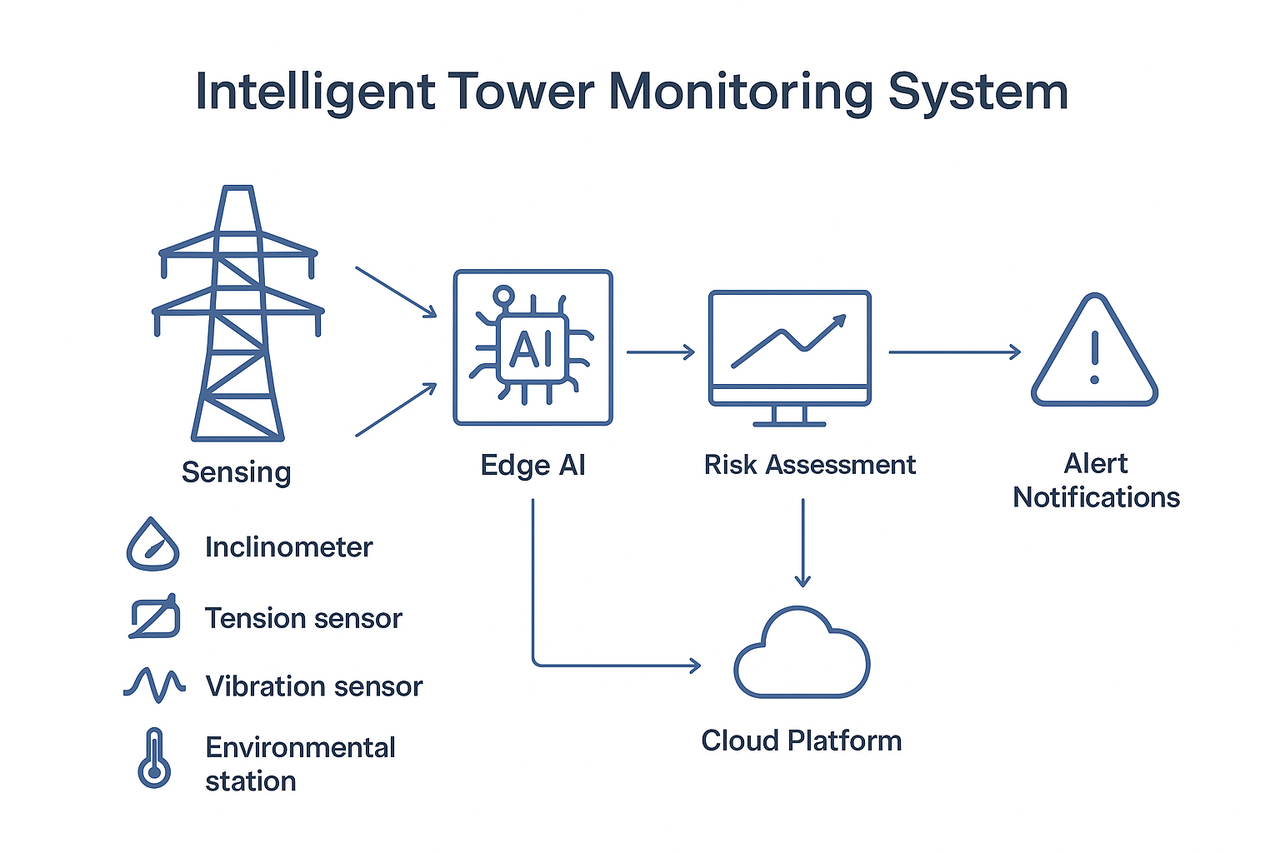
The Intelligent Tower Monitoring System integrates sensors, communication, AI models, and automated alerts. Its design focuses on early detection of stress, loading, anomalies, and environmental threats.
2.1 Multi-Modal Sensing
Modern systems combine:
- Inclination/tilt sensors – detect early structural shifts
- Tension sensors – measure ice load and line sag
- Vibration sensors – capture resonance caused by strong winds
- Environmental stations – wind speed, icing rate, humidity, temperature
- Visual/thermal cameras (optional) – identify physical distortions
This sensor fusion provides a 360° understanding of tower health.
2.2 Edge Computing for Real-Time Decisioning
Raw sensor data is processed by edge AI gateways, enabling:
- On-device anomaly scoring
- Ice-load accumulation prediction
- Wind-induced oscillation modeling
- Early-failure probability estimation
Edge inference shortens response time when every minute counts.
2.3 AI-driven Storm Risk Models
The system combines environmental data with historical patterns to output:
- Typhoon structural risk curves
- Ice-load saturation thresholds
- Forecasted collapse probability
- Wind-oscillation instability forecasts
Instead of alarms after something breaks, utilities receive warnings while failures are still preventable.
How AI Enables Proactive Tower Protection
3.1 Predictive Ice Load Modeling
Using humidity, temperature, wind direction, and wire tension, AI models forecast:
- Where ice will form
- How fast it will accumulate
- When critical thresholds will be exceeded
This enables early decisions—de-icing, rerouting load, or pre-deploying teams.
3.2 Typhoon-Force Crosswind Monitoring
Real-time tower sway patterns help AI determine:
- Whether the base is unstable
- If guy-wire tension is abnormal
- Whether resonance frequency is approaching danger zones
Response teams can secure towers before storm intensity peaks.
3.3 Dynamic Risk Maps
Risk dashboards display:
- High-risk zones
- Expected failure windows
- Tower-by-tower structural health
- Probabilities for cascading failures
This empowers utilities to take strategic actions in advance.
Real-World Operational Benefits
4.1 Prevention Instead of Repair
Most tower collapses provide early signs—tilt, unusual vibration, rising tension—but these signs were historically invisible. Now they trigger alerts days or hours ahead of structural failure.
4.2 Reduced Human Exposure
Climbing iced towers or checking storm-side structures is dangerous.
AI monitoring reduces the need for hazardous field inspections.
4.3 Faster Storm Recovery
After typhoons and blizzards, the system identifies:
- Towers with highest damage probability
- Lines most at risk of outage
- Regions requiring first response
Response teams prioritize with precision.
Core Technologies of TruGem Intelligent Tower Monitoring System
5.1 Centimeter Level Positioning Gateways
These devices perform:
- Local inference
- Data compression
- Low-latency communication
- GNSS/RTK centimeter level positioning for precise inclination tracking
5.2 Integrated IoT Connectivity
Supports:
- 4G/5G
- Satellite fallback
- Low-power wide-area networks (LPWAN)
5.3 Cloud Platform
Provides:
- Historical trend dashboards
- Risk trend analysis
- System-wide health reports
5.4 Three-Level Emergency Alerts
Systems may include:
- Local audio/visual alarms
- SMS/app notifications
- Dispatch-center escalation
Why Intelligent Tower Monitoring Systems Matter Now
Extreme-weather resilience is becoming a strategic priority for utilities.
AI-driven monitoring is no longer “nice to have”—it is emerging as a core safety technology.
The Intelligent Tower Monitoring System helps utilities move from:
- Passive maintenance → Proactive protection
- Weather response → Weather prediction
- Periodic inspection → Continuous monitoring
As climate volatility grows, so does the need for intelligent early-warning infrastructure across global transmission networks.