


The global energy landscape is changing faster than at any point in the last century, and the concept of an Edge-Intelligent Power Grid is rapidly becoming the backbone of this transformation. As power networks integrate distributed energy resources, electrification loads, AI-driven controls, and real-time automation, the traditional centralized grid model is no longer sufficient. Utilities now require intelligence at the edge—not merely for efficiency, but for survival in an increasingly complex, decentralized, and dynamic grid environment.
This blog explores why edge intelligence is becoming essential, how AI-driven technologies are reshaping digital substations and distribution networks, and what kind of advanced gateway devices are required to sustain secure, interoperable, and autonomous grid operations.
Table des matières
- Why the Future Depends on an Edge-Intelligent Power Grid
- From Data to Decisions: The Rise of AI-Driven Grid Automation
- Digital Substation Connectivity: Moving Beyond Legacy Infrastructure
- Real-Time Grid Visibility: The New Operational Baseline
- Distributed Energy Integration and the Role of Edge Intelligence
- Why Substation Gateways Are Becoming the Heart of Edge Intelligence
- Core Requirements for Gateways in Future Digital Substations
- Connecting the Dots: How Advanced Edge Gateways Accelerate Grid Modernization
- Gateway Designed for Edge-Intelligent Power Grids
- Conclusion
Why the Future Depends on an Edge-Intelligent Power Grid
Today’s power grids face a combination of challenges: fluctuating renewable inputs, rising demand peaks, growing cybersecurity threats, aging infrastructure, and expanding distributed assets that require constant monitoring. Centralized control centers cannot react fast enough to every micro-event, nor can they process all data with sufficient granularity for predictive analytics.
This is where an Edge-Intelligent Power Grid becomes indispensable.
Edge intelligence enables:
- Local, real-time decision-making
- AI-Driven Grid Automation without routing all data back to the cloud
- Faster response to anomalies, faults, and disturbances
- Reduced operational latency
- Better situational awareness across substations and distributed nodes
As more utilities integrate distributed energy resources, electric vehicle charging hubs, and sensor-driven IoT infrastructure, the volume of grid data is growing at an exponential rate. The only sustainable way to process and use this data efficiently is by empowering the grid edge.
From Data to Decisions: The Rise of AI-Driven Grid Automation
Artificial intelligence has finally reached a maturity level that allows reliable deployment in real-time power applications. AI models can now analyze high-frequency electrical data, detect patterns invisible to traditional SCADA systems, and autonomously optimize distributed energy flows.
Key capabilities enabled by AI-Driven Grid Automation include:
- Predictive fault detection (before line trips occur)
- Transformer anomaly identification using harmonic signatures
- Load forecasting at micro-grid resolution
- Voltage optimization through real-time analysis
- Automated switching or islanding during failures
AI models deployed locally—inside edge gateways or substation controllers—reduce dependency on central systems and ensure that the grid remains stable even when network conditions degrade.
As more utilities seek to implement Real-Time Grid Visibility, AI becomes the crucial engine transforming raw sensor data into actionable intelligence.
Digital Substation Connectivity: Moving Beyond Legacy Infrastructure
Modern substations are no longer isolated hubs of copper wiring and electromechanical devices. Instead, they are becoming digital ecosystems where thousands of signals—breaker status, temperature, transformer load, harmonic data, vibration patterns—interact continuously.
However, the challenge is clear:
Substations still rely on dozens of different protocols and communication standards.
This is why Digital Substation Connectivity is a core pillar of the Edge-Intelligent Power Grid. It enables seamless data flow between:
- Intelligent Electronic Devices (IEDs)
- SCADA and EMS systems
- Protection relays
- Distributed sensors
- AI-enabled gateways
- Remote control centers
In practice, this requires interoperability across old and new standards including:
- IEC 61850
- IEC 101/104
- Modbus RTU/TCP
- MQTT for cloud/IoT integration
- Vendor-specific serial protocols
As utilities modernize, they must deploy gateways capable of bridging all these protocols securely while supporting real-time analytics.
Real-Time Grid Visibility: The New Operational Baseline
Operational decision-making in the power sector used to rely on scheduled data polling and long control cycles. But with renewables introducing volatility and distributed assets pushing intelligence outward, utilities now need Real-Time Grid Visibility as a fundamental capability, not a luxury.
This means:
- Continuous monitoring of feeders, substations, poles, and distributed assets
- Event-based data collection rather than interval-based
- Real-time anomaly alerts sent to operators
- Fast, automated reactions at the edge when needed
Edge devices equipped with AI accelerate these capabilities dramatically.
For example, instead of waiting for SCADA polling intervals, edge gateways can:
- Detect transformer overheating in seconds
- Identify abnormal breaker oscillations
- Run localized power quality analysis
- Distinguish between fault transients and noise
- Push only meaningful events to the cloud, reducing bandwidth
Such intelligence not only prevents outages but also extends asset lifespan and enhances reliability indices (SAIDI/SAIFI).
Distributed Energy Integration and the Role of Edge Intelligence
The rapid expansion of renewable energy sources—solar farms, wind turbines, EV chargers, and community microgrids—has turned the distribution grid into a highly dynamic environment. Traditional centralized coordination models struggle with fast-changing power flows and bidirectional energy exchange.
An Edge-Intelligent Power Grid supports distributed orchestration by:
- Providing local control for DERs
- Running AI models to optimize voltage and frequency
- Applying real-time dispatching logic
- Automatically balancing loads and generation
- Managing inverter behaviors during disturbances
This reduces the load on central operators and ensures system resilience even with high renewable penetration.
Why Substation Gateways Are Becoming the Heart of Edge Intelligence
At the foundation of all trends above lies a crucial component:
the industrial edge gateway.
A modern power grid gateway is no longer just a protocol converter. It must serve as a:
- Data concentrator
- IoT hub
- Security firewall
- AI inference controller
- Protocol-Integrated Gateway
- IT-OT convergence device
- Communication bridge across LAN, RS232, RS485, DI/DO
Gateways have evolved into compact “mini data centers” at the substation edge.
To support the Edge-Intelligent Power Grid, a next-generation gateway must satisfy several requirements.
Core Requirements for Gateways in Future Digital Substations
1. Multi-Protocol Interoperability
A future-ready gateway must unify legacy OT and modern IoT protocols, including:
- IEC 101/104 for traditional grid communication
- IEC 61850 for digital substations
- Modbus RTU/TCP for sensors and meters
- MQTT for cloud-native IoT systems
This ensures seamless OT-IT Integration and protects utilities from vendor lock-in.
2. AI Execution at the Edge
The gateway should support:
- Deployment of custom AI models
- Real-time inference for anomaly detection
- Event filtering and compression
- AI-driven local decision-making
AI at the edge reduces system latency and increases reliability during network outages.
3. Secure Grid Communication
With rising cyber threats, gateways must embed:
- State Grid encryption algorithm
- Isolated interfaces for OT/IT networks
- Secure boot, device identity, and certificate-based authentication
Security must be integrated end-to-end, not added as an afterthought.
4. Rich I/O Support for Substation Environments
A capable gateway should provide:
- LAN ports for network backhaul
- RS232/RS485 for legacy devices
- DI/DO for relay controls and alarms
This flexibility ensures compatibility with substations of any age.
5. Scalability and Cloud Integration
The gateway must support:
- Hierarchical device management
- Remote configuration
- OTA firmware and AI model updates
- Integration with private 5G or fiber backhaul
Together, these features enable utility-wide observability and rapid deployment cycles.
Connecting the Dots: How Advanced Edge Gateways Accelerate Grid Modernization
By combining AI execution, multi-protocol connectivity, secure communication, and real-time data processing, edge gateways become the core enabler of an Edge-Intelligent Power Grid.
They translate signals, analyze data, execute decisions, protect communications, and connect substations with cloud platforms—all within milliseconds. Without capable gateways, digital transformation efforts simply cannot scale.
This is why utilities are increasingly seeking a single device that can:
- Integrate all protocols
- Run AI at the edge
- Support modern IoT messaging
- Bridge legacy and digital systems
- Protect data with SM-grade encryption
- Provide reliable interfaces for field equipment
A new generation of gateway hardware is emerging—purpose-built to support the modern grid.
Gateway Designed for Edge-Intelligent Power Grids
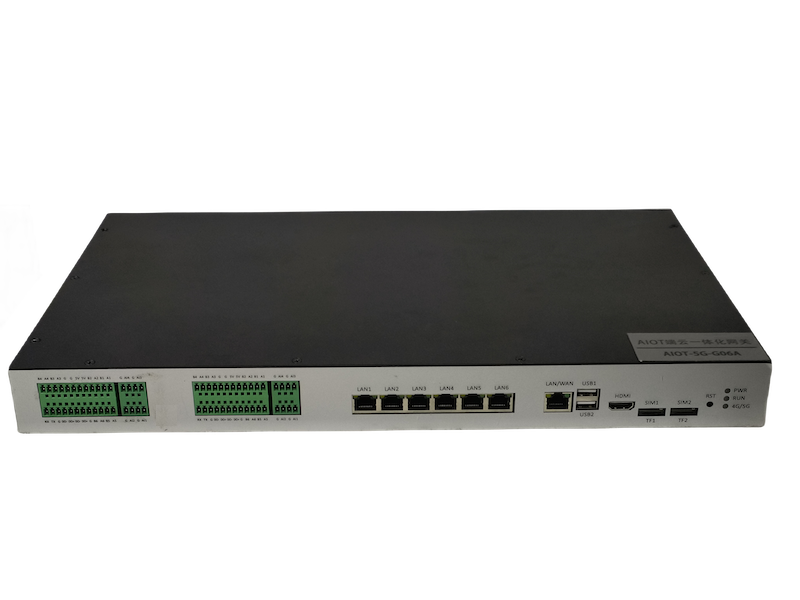
To support utilities building a resilient and future-ready grid, the TruGem Power Grid AIoT gateway AIoT-5G-G06 is engineered specifically for next-generation digital substations and distributed power networks.
Les principales capacités sont les suivantes
- Support for IEC 101/104, IEC 61850, Modbus RTU/TCP, and MQTT
- AI model import and real-time edge inference
- State Grid encryption algorithm for trusted communication
- LAN, RS232, RS485, DI/DO interfaces for universal equipment connectivity
- High-performance processing for real-time grid visibility
- Robust industrial reliability for substation environments
Whether used for transformer monitoring, feeder automation, distributed energy integration, or digital substation modernization, this gateway serves as the connective tissue enabling an Edge-Intelligent Power Grid.
Conclusion
As energy systems evolve toward decentralization, electrification, and AI-driven automation, utilities must move beyond traditional architectures and embrace edge intelligence as a foundational strategy. The Edge-Intelligent Power Grid is not a concept—it is an operational necessity.
With AI-powered decision-making, multi-protocol interoperability, digital substation connectivity, and secure communication, advanced edge gateways form the backbone of the grid’s next generation. And with a gateway capable of bridging legacy infrastructure with modern IoT and AI capabilities, utilities can accelerate digital transformation while ensuring reliability, security, and resilience.